|
UPnPsdk 0.1
Universal Plug and Play +, Software Development Kit
|
|

| |
|
UPnPsdk 0.1
Universal Plug and Play +, Software Development Kit
|
|
|
| |
The URI module contains all classes and free functions to manage Uniform Resource Identifier (URI) as specified with RFC 3986. More...
Classes | |
| class | UPnPsdk::CComponent |
| Base class of a component. More... | |
| class | UPnPsdk::CScheme |
| Scheme component of a URI. More... | |
| class | UPnPsdk::CUserinfo |
| Userinfo subcomponent from an authority component of a URI reference. More... | |
| class | UPnPsdk::CHost |
| Host subcomponent from an authority component of a URI reference. More... | |
| class | UPnPsdk::CPort |
| Port subcomponent from an authority component of a URI reference. More... | |
| class | UPnPsdk::CAuthority |
| Authority component of a URI reference. More... | |
| class | UPnPsdk::CPath |
| Path component of a URI reference. More... | |
| class | UPnPsdk::CQuery |
| Query component of a URI reference. More... | |
| class | UPnPsdk::CFragment |
| Fragment component of a URI reference. More... | |
| class | UPnPsdk::CPrepUriStr |
| Internal class to prepare the input URI string, Not publicly usable. More... | |
| class | UPnPsdk::CUriRef |
| This is a URI reference. More... | |
| class | UPnPsdk::CUri |
| Representing a URI that can be modified with a relative reference. More... | |
Functions | |
| UPnPsdk_VIS void | UPnPsdk::remove_dot_segments (std::string &a_path) |
| Remove dot segments from a path. | |
| UPnPsdk::CPrepUriStr::CPrepUriStr (std::string &a_uriref_str) | |
| Initialize the helper class. | |
| UPnPsdk_VIS int | parse_uri (const char *in, size_t max, uri_type *out) |
| Parses a uri as defined in RFC 3986 (Uniform Resource Identifier). | |
| bool | UPnPsdk::anonymous_namespace{uri.cpp}::is_ipv4_addr (const std::string &ip) |
| Check if string is a valid IPv4 address. | |
| bool | UPnPsdk::anonymous_namespace{uri.cpp}::is_dns_name (const std::string &label) |
| Check if a string conforms to a DNS name. | |
| std::string_view | UPnPsdk::anonymous_namespace{uri.cpp}::get_scheme (std::string_view a_uri_sv) |
| Separates the scheme component from a URI. | |
| std::string_view | UPnPsdk::anonymous_namespace{uri.cpp}::get_authority (std::string_view a_uriref_sv) |
| Separates the authority component from a URI reference. | |
| std::string_view | UPnPsdk::anonymous_namespace{uri.cpp}::get_userinfo (std::string_view a_uriref_sv) |
| Separates the authority userinfo subcomponent from a URI reference. | |
| std::string_view | UPnPsdk::anonymous_namespace{uri.cpp}::get_host (std::string_view a_uriref_sv) |
| Separates the authority host subcomponent from a URI reference. | |
| std::string_view | UPnPsdk::anonymous_namespace{uri.cpp}::get_port (std::string_view a_uriref_sv) |
| Separates the authority port subcomponent from a URI reference. | |
| std::string_view | UPnPsdk::anonymous_namespace{uri.cpp}::get_path (std::string_view a_uriref_sv) |
| Separates the path component from a URI reference. | |
| std::string_view | UPnPsdk::anonymous_namespace{uri.cpp}::get_query (std::string_view a_uriref_sv) |
| Separates the query component from a URI reference. | |
| std::string_view | UPnPsdk::anonymous_namespace{uri.cpp}::get_fragment (std::string_view a_uriref_sv) |
| Separates the fragment component from a URI reference. | |
| void | UPnPsdk::anonymous_namespace{uri.cpp}::merge_paths (CPath &a_path, const CUriRef &a_base, const CUriRef &a_rel) |
| Merge a relative reference to a base URI. | |
The URI module contains all classes and free functions to manage Uniform Resource Identifier (URI) as specified with RFC 3986.
It follows the recommendation of RFC 3986 4.1.:
A URI-reference is typically parsed first into the five URI components, in order to determine what components are present and whether the reference is relative.
All thrown exceptions from this module are std::invalid_argument.
It is the UPnPsdk::CComponent class. It specifies the common properties of a component and is base class of every named component class.
All five named components scheme, authority with subcomponents userinfo and host and port, path, query, fragment have its own class that is derived from UPnPsdk::CComponent. They are all initialized by their constructors with the whole input URI string to ensure they all have the same source for parsing and extract its specific information as defined by RFC 3986. Their Attributes are protected so there is only access to them with "getter" member functions.
The constructor of a named component class always tries to extract its component from the input URI string and reflects it in its UPnPsdk::CComponent::STATE. No dependencies with other components are checked on this abstraction layer. Only conditions like valid characters etc. defined for the component are checked. For example no error is reported if a "http" URI does not have a host component available. This is checked on a higher abstraction layer that manage the dependencies of components.
This is the UPnPsdk::CUriRef class, the representation of a URI reference. Its member variables are named component objects. The constructor only verifies a URI. It always accepts a valid relative reference because that only makes sense together with a URI that is used as base URI for a relative reference. Verifying the relative reference is made on a higher abstraction layer that merges the base URI and the relative reference.
This is the UPnPsdk::CUri class. Its member variables are mainly two UPnPsdk::CUriRef objects for base URI and resulting target URI. The constructor initializes the base URI. The class accepts an optional relative reference and will then transform it with the base URI to a resulting target URI if it is valid.
| void UPnPsdk::remove_dot_segments | ( | std::string & | a_path | ) |
Remove dot segments from a path.
This function directly implements the "Remove Dot Segments" algorithm described in RFC 3986 section 5.2.4. If it cannot find something to remove it just do nothing with the path.
Examples:
| [in,out] | a_path | Reference of a string representing a path with '/' separators and possible containing ".." or "." segments. The path is modified in place. |
Definition at line 73 of file uri.cpp.
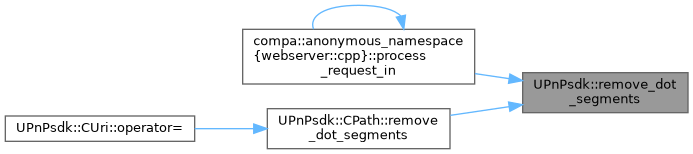
 Here is the caller graph for this function:
| UPnPsdk::CPrepUriStr::CPrepUriStr | ( | std::string & | a_uriref_str | ) |
Initialize the helper class.
Normalize percent encoded characters of a URI reference string to upper case hex digits (RFC3986_2.1.)
Corrections are made in place. The size of the corrected string doesn't change.
| std::invalid_argument | if invalid percent encoding is detected. |
| [in] | a_uriref_str | Input URI string |
| UPnPsdk_VIS int parse_uri | ( | const char * | in, |
| size_t | max, | ||
| uri_type * | out | ||
| ) |
Parses a uri as defined in RFC 3986 (Uniform Resource Identifier).
Handles absolute, relative, and opaque uris. Parses into the following pieces: scheme, hostport, pathquery, fragment (host with port and path with query are treated as one token). Strings in output uri_type are treated as token with character chain and size. They are not null ('\0') terminated.
Caller should check for the pieces they require.
| [in] | in | Character string containing uri information to be parsed. It is not expected to be terminated with zero ('\0'), but may have. |
| [in] | max | Number of characters (strlen()) of the input string. |
| [out] | out | Output parameter which will have the parsed uri information. |
Definition at line 1111 of file uri.cpp.
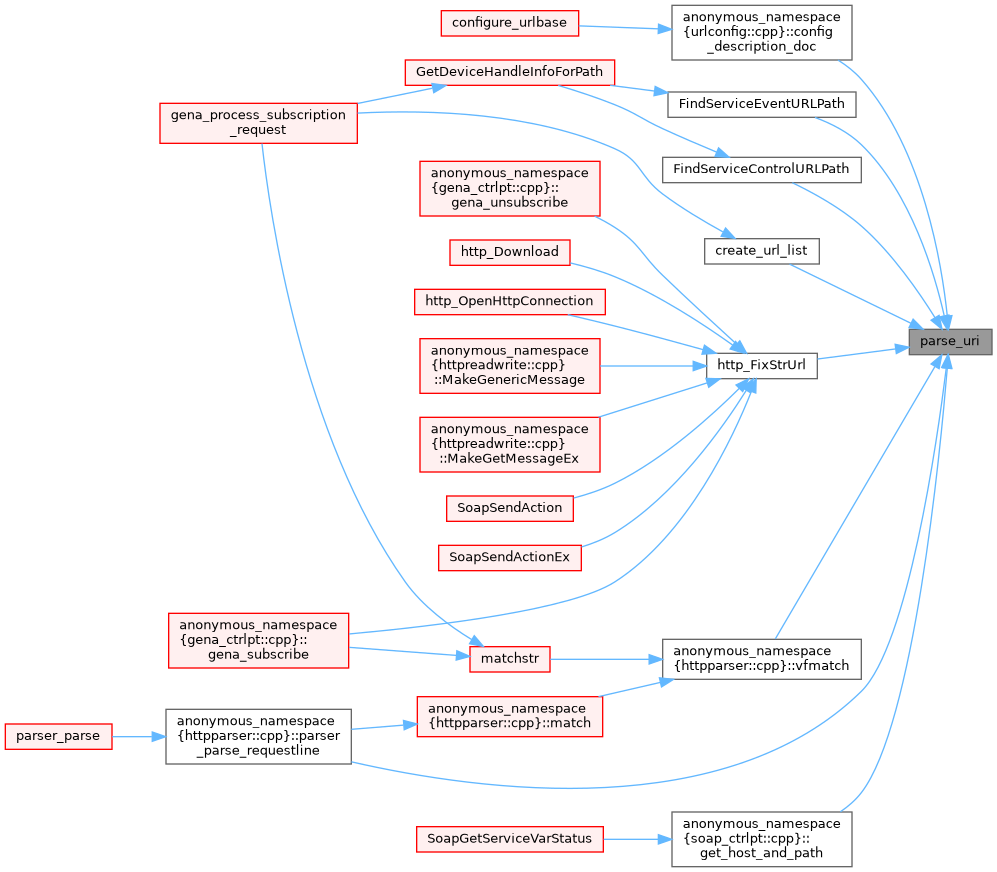
Here is the call graph for this function: Here is the caller graph for this function:| bool UPnPsdk::anonymous_namespace{uri.cpp}::is_ipv4_addr | ( | const std::string & | ip | ) |
Check if string is a valid IPv4 address.
This checks that the address consists of four octets, each ranging from 0 to 255, separated by dots.
| [in] | ip | String to test. |
Definition at line 39 of file uri.cpp.
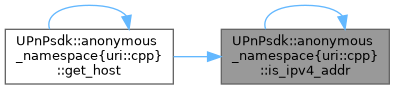
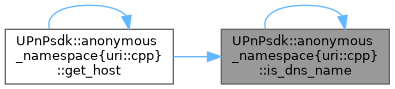
Here is the call graph for this function: Here is the caller graph for this function:| bool UPnPsdk::anonymous_namespace{uri.cpp}::is_dns_name | ( | const std::string & | label | ) |
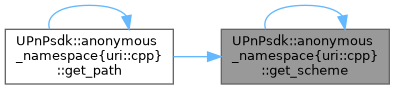
| std::string_view UPnPsdk::anonymous_namespace{uri.cpp}::get_scheme | ( | std::string_view | a_uri_sv | ) |
Separates the scheme component from a URI.
| [in] | a_uri_sv | URI to parse |
Definition at line 203 of file uri.cpp.
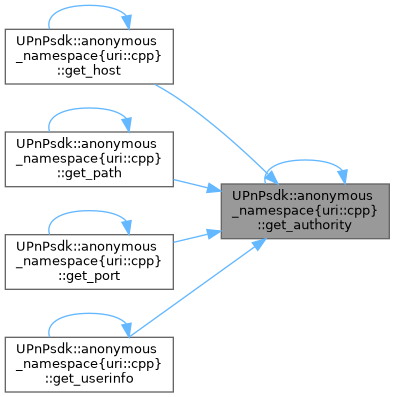
Here is the call graph for this function: Here is the caller graph for this function:| std::string_view UPnPsdk::anonymous_namespace{uri.cpp}::get_authority | ( | std::string_view | a_uriref_sv | ) |
Separates the authority component from a URI reference.
A sender MUST NOT generate an "http" URI with an empty host identifier. A recipient that processes such a URI reference MUST reject it as invalid (RFC7230 2.7.1.). This means an authority component is mandatory for "http[s]".
| [in] | a_uriref_sv | URI reference to parse. |
Definition at line 292 of file uri.cpp.
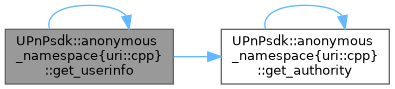
Here is the call graph for this function: Here is the caller graph for this function:| std::string_view UPnPsdk::anonymous_namespace{uri.cpp}::get_userinfo | ( | std::string_view | a_uriref_sv | ) |
Separates the authority userinfo subcomponent from a URI reference.
| [in] | a_uriref_sv | URI reference to parse |
Definition at line 332 of file uri.cpp.
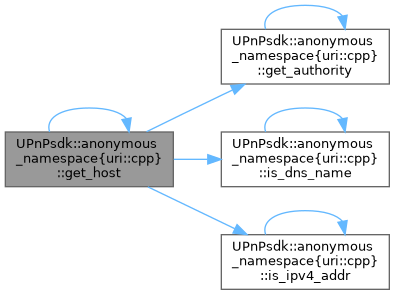
Here is the call graph for this function: Here is the caller graph for this function:| std::string_view UPnPsdk::anonymous_namespace{uri.cpp}::get_host | ( | std::string_view | a_uriref_sv | ) |
Separates the authority host subcomponent from a URI reference.
| std::invalid_argument | if URI reference with invalid host address or host name pattern is detected. No DNS lookup is performed. |
| [in] | a_uriref_sv | URI reference to parse |
Definition at line 419 of file uri.cpp.
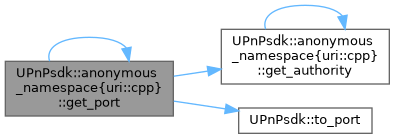
Here is the call graph for this function: Here is the caller graph for this function:| std::string_view UPnPsdk::anonymous_namespace{uri.cpp}::get_port | ( | std::string_view | a_uriref_sv | ) |
Separates the authority port subcomponent from a URI reference.
| std::invalid_argument | if invalid port number is detected. |
| [in] | a_uriref_sv | URI reference to parse |
Definition at line 533 of file uri.cpp.
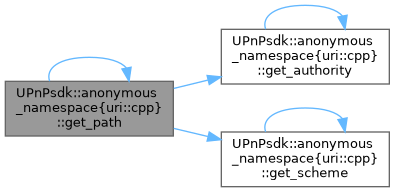
Here is the call graph for this function: Here is the caller graph for this function:| std::string_view UPnPsdk::anonymous_namespace{uri.cpp}::get_path | ( | std::string_view | a_uriref_sv | ) |
Separates the path component from a URI reference.
| [in] | a_uriref_sv | URI reference to parse |
Definition at line 669 of file uri.cpp.
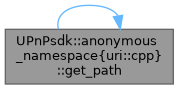
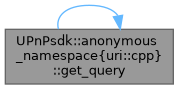
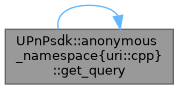
Here is the call graph for this function: Here is the caller graph for this function:| std::string_view UPnPsdk::anonymous_namespace{uri.cpp}::get_query | ( | std::string_view | a_uriref_sv | ) |
Separates the query component from a URI reference.
| [in] | a_uriref_sv | URI reference to parse |
Definition at line 747 of file uri.cpp.
Here is the call graph for this function: Here is the caller graph for this function:| std::string_view UPnPsdk::anonymous_namespace{uri.cpp}::get_fragment | ( | std::string_view | a_uriref_sv | ) |
Separates the fragment component from a URI reference.
| [in] | a_uriref_sv | URI reference to parse |
Definition at line 816 of file uri.cpp.
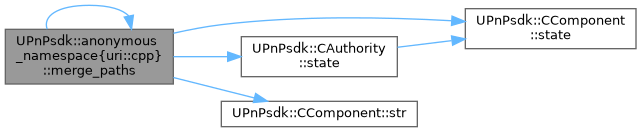
Here is the call graph for this function: Here is the caller graph for this function:| void UPnPsdk::anonymous_namespace{uri.cpp}::merge_paths | ( | CPath & | a_path, |
| const CUriRef & | a_base, | ||
| const CUriRef & | a_rel | ||
| ) |
Merge a relative reference to a base URI.
| [out] | a_path | Resulting merged paths object |
| [in] | a_base | base URI object |
| [in] | a_rel | Relative reference object |
Definition at line 1001 of file uri.cpp.
Here is the call graph for this function: Here is the caller graph for this function: 1.9.8
1.9.8